




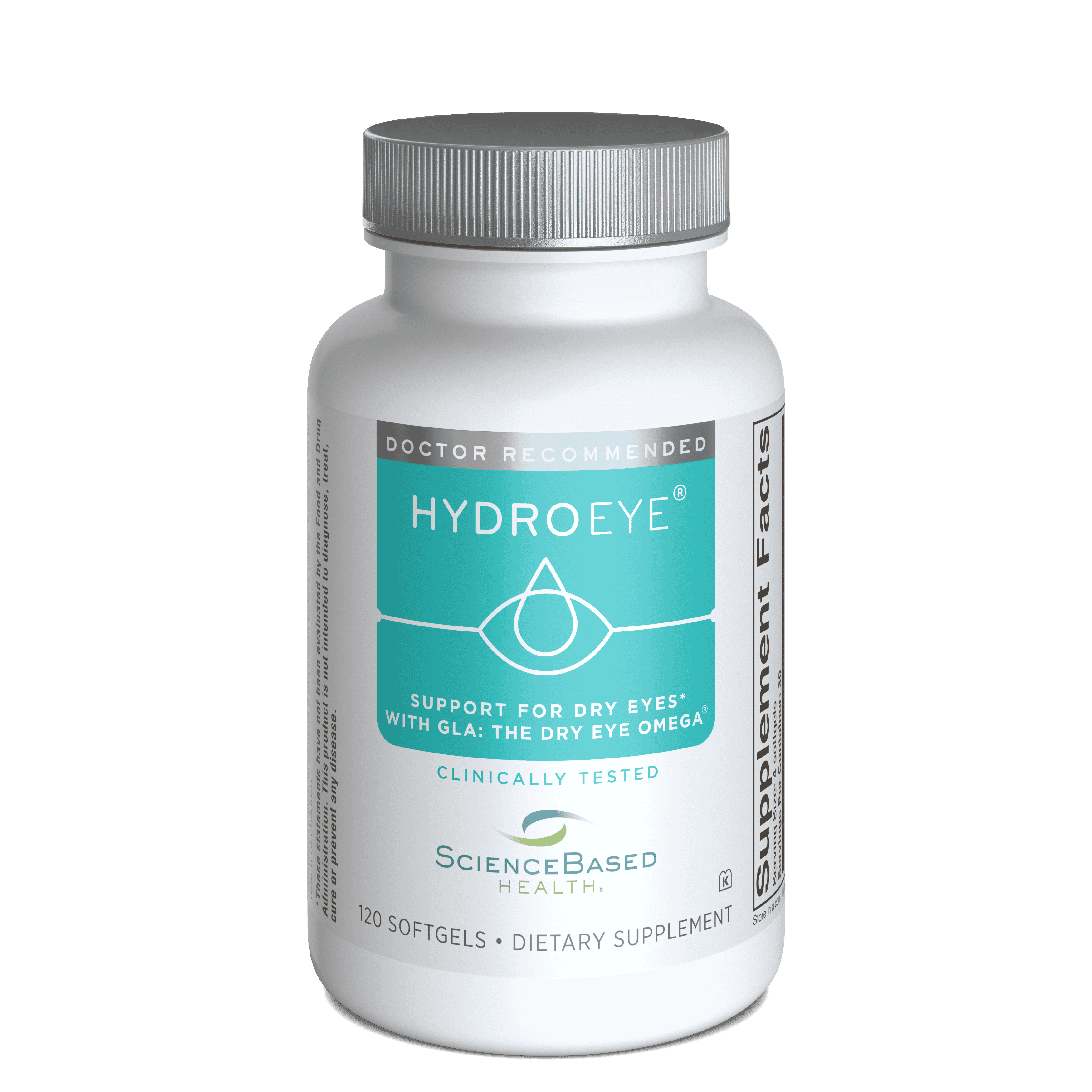
The HydroEye® clinical trial is one of the only randomized controlled clinical trials to show significant dry eye relief with a nutritional product. The study was published in October 2013, in the peer-reviewed journal Cornea.
This trial was conducted by two highly respected dry eye researchers: John D. Sheppard, MD, MMSc at Virginia Eye Consultants and Eastern Virginia Medical School and Stephen C. Pflugfelder, MD at the Cullen Eye Institute, Baylor College of Medicine.
Overview:
The researchers found that the group taking HydroEye had a significant improvement in irritation symptoms, a smoother corneal surface, and lower levels of inflammatory biomarkers compared to those in the placebo group.
Methods
In this multi-center, randomized, controlled trial, 38 postmenopausal women with Dry Eye Syndrome (moderate to severe KCS) received 4 softgels daily of HydroEye® or placebo, and were evaluated at 0, 4, 12, 24 weeks for a number of efficacy outcomes. Conjunctival impression cytologies were obtained (pressing a membrane to the conjunctiva to collect cell samples) and stained for inflammatory biomarkers HLA-DR & CD11c.

Dry Eye Symptoms
A progressive improvement in mean OSDI (Ocular Surface Disease Index**, a validated questionnaire for evaluating dry eye symptom severity) was noted with supplement treatment throughout the study period, and was significant after 12 and 24 weeks compared to baseline (p=0.004). After 24 weeks, supplement treatment significantly improved OSDI scores when compared to placebo (p=0.05).
Markers of Inflammation
HLA-DR and CD11c are inflammatory biomarkers. HLA-DR is a dendritic cell activation marker that increases when exposed to inflammatory cytokines. CD11c is a molecule on certain dendritic cells that regulates their migration.
Ocular Surface Inflammation
After 24 weeks, HydroEye® prevented any increase in the number of HLA-DR (Class II antigen) positive dendritic conjunctival cells as well as CD11c positive cells. In contrast, these cells significantly increased in placebo takers (p=0.03 & 0.004, respectively). At the trial’s end, HLA-DR & CD11c levels were significantly lower in HydroEye® vs. placebo subjects (p=0.001).
Corneal Surface Smoothness
Topographic corneal regularity indices (SRI and SAI) have been reported to increase in dry eye, and an irregular corneal surface can contribute to both irritation and problematic visual symptoms. These indices were assessed in study participants as measures of corneal smoothness. There was no change in the SAI in the supplement-treated group, while the SAI increased in placebo-treated subjects reaching statistical significance between the groups at 24 weeks (p=0.005). No between-group differences were noted for SRI.
Summary of Findings
HydroEye® significantly improved dry eye symptoms in this patient population.
No progression of ocular surface inflammation or corneal irregularity was seen in the HydroEye-treated group, while the placebo group worsened over the six-month testing period.
 “The data from the HydroEye clinical trial is impressive. People may not realize just how difficult it is to obtain significant findings in clinical trials with dry eye. You have to have a pretty potent effect to overcome the variability that’s inherent in these kinds of trials.”
— Michael Lemp, MD
Conclusion
HydroEye® taken for 6 months significantly improves dry eye symptoms, suppresses markers of ocular surface inflammation, and maintains corneal surface smoothness in post-menopausal women with KCS.
 Click here to learn more about HydroEye
 "This is the most meaningful study to date on a nutritional supplement’s role in dry eye."
 - Stephen C. Pflugfelder, MD
 "This is a prospective, masked, randomized, placebo controlled, multi-center study conducted as would be any FDA registration trial, and monitored under the most stringent standards."
 - John D. Sheppard, MD, MMSc
“These are impressive results, since reaching significance for multiple study endpoints typically requires far more clinical trial participants.” - Stephen C. Pflugfelder, MD
“Statistical significance in any dry eye study is a remarkable achievement, especially considering the exceptional difficulty experienced by numerous pharmaceutical companies attempting to bring a new dry eye therapeutic to the marketplace over the past decade. Thus, our data becomes even more remarkable.” - John D. Sheppard, MD, MMSc